

How Much Mithai Should You Order for 20, 50 or 100 Guests?
Twenty guests sharing mithai after dinner need a different order from twenty guests taking a box home. Add cake, a buffet or a few extra relatives, and the calculation changes again. Getting the mithai quantity for guests right starts with deciding what each person will actually receive.
A useful starting point is 100g per guest for a standard serving, with a separate allowance for seconds or unexpected arrivals. Smaller portions may suit a meal with several desserts, while a mithai-focused spread may call for more. These are planning choices, so the sweets you select and their actual piece sizes still matter.
Below, you will find quantities for 20, 50 and 100 guests, a simple calculation method and examples showing how to adjust an order without buying unnecessary kilos. Take-home gifts are calculated separately so they do not disappear into the serving estimate.
Quick Answer: How Much Mithai Do You Need?
At 100g per guest plus 10% extra, plan 2.2kg for 20 guests, 5.5kg for 50 guests or 11kg for 100 guests. If the shop sells in half-kilo increments, round 2.2kg up to 2.5kg. These estimates cover served mithai; take-home boxes are additional.
This standard scenario gives you a starting order to discuss with the shop. Choose a lighter or more generous portion below if your menu calls for it.
Choose Your Serving Size Before Counting Kilos
The most useful question is what role mithai plays in the meal. A small sweet alongside cake is different from a plate of mithai served as the main dessert.
Use these three scenarios to compare your options:
| Serving plan | Assumed amount per guest | When to consider it |
| Light | 60g | A modest portion alongside other desserts |
| Standard | 100g | A regular mithai dessert portion |
| Generous | 150g | A larger portion or a mithai-focused spread |
These figures are working assumptions, not fixed catering standards or measured predictions of what every guest will eat. Choose the closest fit, then check the actual products.
For example, two small pieces weighing 30g each fit the light scenario. Two larger pieces weighing 50g each already reach the standard allowance. The instruction “two pieces per person” therefore needs a piece-size check before it becomes a reliable order.
Think about how you will serve the sweets, too. Individually plated portions are easier to count. With shared trays, guests choose their own portions, so your estimate needs room for that variation.
Mithai Quantity Chart for 20, 50 and 100 Guests
The following table includes a 10% extra allowance in every figure. It assumes all listed guests will receive mithai and excludes take-home gifts.
| Guests | Light: 60g each + 10% | Standard: 100g each + 10% | Generous: 150g each + 10% |
| 20 | 1.32kg | 2.20kg | 3.30kg |
| 50 | 3.30kg | 5.50kg | 8.25kg |
| 100 | 6.60kg | 11.00kg | 16.50kg |
Do not add another 10% to these totals. The spare quantity is already included.
Round to the quantities your shop supplies
If you can order in 0.5kg increments, the calculated totals become:
| Guests | Light order | Standard order | Generous order |
| 20 | 1.5kg | 2.5kg | 3.5kg |
| 50 | 3.5kg | 5.5kg | 8.5kg |
| 100 | 7kg | 11kg | 16.5kg |
These rounded quantities depend on half-kilo increments being available. If a particular item comes only in sealed 1kg packs, round that item to whole packs instead. Custom catering orders may follow different minimums.
Rounding adds a little more than the planned buffer in some cases. For twenty guests, 2.5kg is 500g above the original 2kg standard serving estimate, even though the calculation initially added only 200g.
Calculate an Order for Any Guest Count
To calculate mithai quantity for guests beyond the table, use:
Total kilograms = guests × grams per guest ÷ 1,000 × (1 + extra allowance).
Write 10% as 0.10 and 15% as 0.15. Calculate the base quantity first if that feels simpler, then add the extra amount.
For 35 guests at 100g each:
- Base quantity: 35 × 100g = 3,500g, or 3.5kg.
- Extra 10%: 3.5kg × 0.10 = 0.35kg.
- Calculated total: 3.85kg.
- Order rounded to the next half kilo: 4kg.
The same method works for a family gathering, office celebration or wedding reception. What changes is your portion assumption and the number of people you need to serve.
Count anyone receiving a portion, including hosts or helpers if you plan to serve them. Known attendees belong in the base count rather than being left for the spare allowance to cover.
Turn Mithai Pieces Into a Weight Estimate
Kilograms are useful for purchasing, but pieces are often easier for planning a plate. Connect the two by asking the shop for the approximate weight or count of your chosen sweets.
Required pieces = guests × pieces per guest.
Then add your chosen extra allowance and round up to whole pieces. To estimate kilograms, multiply that piece count by the average piece weight and divide by 1,000.
For example, fifty guests receiving two 40g pieces each need 100 pieces before extras. With 10% added, the order becomes 110 pieces, weighing approximately 4.4kg. If supplied by weight in half-kilo increments, that would round to 4.5kg. Confirm the piece count, since handmade sizes may vary.
Why one kilogram does not have a fixed piece count
The following examples show the arithmetic, not standard weights for particular RIVAAJ products:
| Assumed average piece weight | Approximate pieces in 1kg |
| 25g | 40 |
| 40g | 25 |
| 50g | 20 |
Barfi thickness, ladoo size and chum chum portions can differ between batches or sellers. Ask about the actual sweets you intend to order instead of relying on a universal pieces-per-kilo figure.
For gulab jamun and other syrup sweets, confirm whether the quoted weight includes surrounding syrup. A pack weighing 1kg does not necessarily contain 1kg of sweet pieces. Piece count is particularly useful when you want to give every guest the same number.
Add Extra Portions Without Counting Them Twice
An extra allowance covers uncertainty. It should be visible in your calculation, so you know how much you have ordered beyond the planned servings.
The tables use 10% as a straightforward planning example. It is not a guarantee against every change in attendance. If your numbers are less certain, compare a larger allowance with the likely need rather than automatically choosing the biggest order.
For fifty guests at 100g each, a 10% allowance gives 5.5kg. A 15% allowance gives 5.75kg, which rounds to 6kg in half-kilo increments. That makes the cost of the additional margin easy to assess.
If ten extra guests become confirmed, update the guest count. Do not continue treating those people as unexpected arrivals.
Also check whether the shop’s recommendation already includes spare portions. If you request “enough for fifty guests with some extra” and receive a suggested weight, ask what portion size and allowance it represents before adding more yourself.
Keep a separate serving tray for your reserve if that suits the event. Refill from it as needed, following the shop’s storage and serving instructions, rather than putting the whole order out at once.
Adjust for Other Desserts, Children and Repeat Servings
A guest list tells you how many people are coming. The menu tells you what else they are likely to eat.
When cake or another dessert is included
If each guest will receive cake as well as mithai, a smaller mithai portion may fit your plan. For fifty guests, the light scenario of 60g each plus 10% gives 3.3kg, rounded to 3.5kg where half-kilo ordering is available.
That estimate only makes sense if you intend a light mithai serving. Serving cake does not automatically mean every guest wants fewer sweets. Consider what your group enjoys and whether the desserts appear together or at different points in the event.
When adults and children have different portions
There is no need to assume every child eats exactly half an adult portion. If you know smaller portions suit your event, calculate those separately.
For example, 40 adult portions at 100g and 10 smaller portions at 60g give:
4kg + 0.6kg = 4.6kg before extras.
Adding 10% brings the total to 5.06kg, or 5.5kg rounded to the next half kilo. These are chosen portion sizes, not age-based dietary recommendations.
When mithai will be served more than once
Decide whether your per-person allowance covers the whole event or one serving. If you plan separate rounds at arrival and after dinner, account for both. Do not use a single light-serving estimate for two planned rounds and expect the buffer to supply the second.
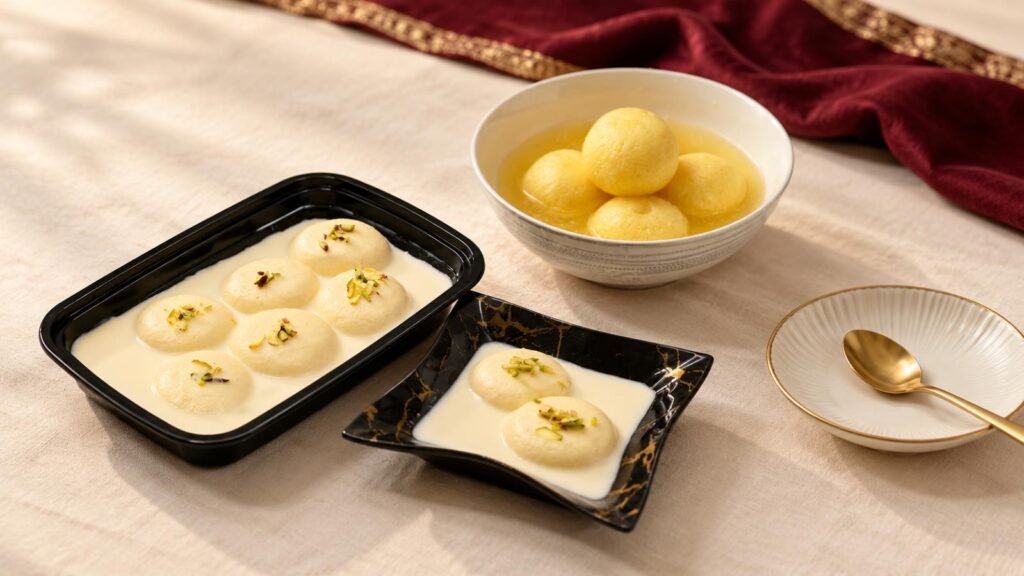
Divide the Total Between Mithai Varieties
Once you have the total order, decide how to divide it. Choosing three varieties does not mean ordering the full guest quantity three times.
For a 5.5kg mixed mithai order, one possible allocation is:
| Variety | Example allocation |
| Barfi | 2kg |
| Ladoo | 2kg |
| Pista Pak | 1.5kg |
| Total | 5.5kg |
This is a planning example, not a fixed package. Change the split to suit your group and the available products.
Weight allocation works well for shared trays where guests choose what they want. For a plated dessert, use counts first. If every guest should receive one piece of each of three varieties, confirm the weight of that three-piece serving and calculate each variety’s required count.
For instance, pieces weighing 30g, 40g and 30g make a 100g serving. Three 50g pieces make a 150g serving. Both are three-piece plates, but the second requires substantially more mithai.
Keep Take-Home Boxes Separate From Event Servings
Mithai served at the event and sweets sent home need separate lines on your order. Otherwise, you may finish dessert service with too little left for the gifts.
For household gifts, count the boxes you intend to distribute. Fifty attending guests do not necessarily mean fifty take-home boxes.
Suppose you are serving fifty guests using the standard plan, then giving twenty households a 250g box each:
| Part of the order | Quantity |
| Served mithai, including 10% extra | 5.5kg |
| Twenty take-home boxes at 250g each | 5kg |
| Combined quantity | 10.5kg |
The take-home calculation contains no spare boxes. If you want two additional boxes, add another 500g, making 11kg overall. You do not need to apply another blanket 10% to the already-buffered serving quantity.
Ask for the take-home boxes to be packed and set aside separately. That keeps a planned gift from being opened accidentally to refill the dessert table.
Confirm Your Bulk Mithai Order in Riyadh
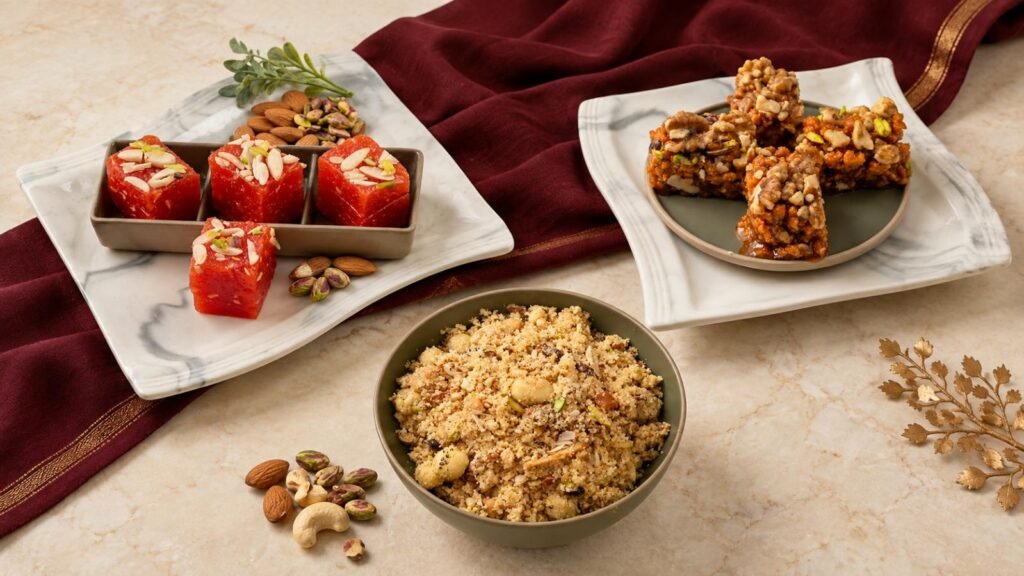
Before requesting mithai catering in Riyadh, prepare a short order summary. A clear brief lets the shop check your assumptions against its actual product sizes and available quantities.
Include:
- Confirmed guest count and any separately planned smaller portions.
- Whether mithai is the main dessert or accompanies other sweets.
- Your selected varieties and intended pieces per person, if applicable.
- Calculated serving weight and the extra allowance already included.
- Take-home box quantities listed separately.
- Event date, serving time and collection or delivery requirements.
RIVAAJ offers a catering enquiry service for events in Riyadh. Share your calculation and ask the team to confirm the appropriate product quantities, current quote and required notice.
For a piece-based plan, request approximate pieces per kilogram for each selected variety. For syrup sweets, ask about the supplied weight basis. Confirm minimum order increments, too, because a mathematically precise quantity may need rounding to match the available packs.
Follow the supplied storage instructions until serving. Avoid treating an extra allowance as a reason to order far more than you can serve, distribute or store appropriately.
Frequently Asked Questions
At 100g per guest, 2kg covers twenty planned servings with no extra allowance. Adding 10% gives 2.2kg. If half-kilo increments apply, that becomes a 2.5kg order. A lighter portion could require less, depending on the other desserts and actual piece sizes.
It provides exactly 100g per person before any spare portions. For that same serving size with 10% extra, plan 5.5kg. If you choose 150g portions, the total rises to 8.25kg including the allowance, so the serving assumption determines the answer.
Using the article’s standard assumption, 100 guests need 10kg before extras and 11kg with a 10% allowance. The light and generous scenarios calculate to 6.6kg and 16.5kg respectively. Check the menu and portion size before selecting a total.
Before extras, 1kg provides ten 100g servings or twenty 50g servings. The number changes with your chosen portion. For sweets distributed as whole pieces, check the actual piece count as well, since weight alone may not divide neatly between guests.
If your plan is two per guest, start with 100 gulab jamun. Add 10% for a total of 110 pieces. Ask the seller what that count weighs and whether syrup is included in the price-by-weight calculation. Larger pieces may suit a different serving plan.
Variety alone does not determine the total. Start with the portion you intend each guest to receive, then divide it among the chosen sweets. If everyone gets one of every variety, calculate the combined weight of that serving before placing the order.
Planned gifts should have their own quantity. The serving allowance is there for uncertainty during the event. Count the intended boxes, multiply by their net sweet weight and add that amount separately. This avoids relying on leftovers to complete your gift list.
A clear portion plan makes the mithai quantity for guests easier to manage. Choose the serving size, calculate the weight, add one allowance and round to the quantities available. Share that plan with the shop so your final order matches both the occasion and the sweets being served.