
Every piece of traditional Pakistani mithai carries a story that is centuries old. Behind the golden shimmer of Gulab Jamun syrup, the crumbly sweetness of Barfi, and the delicate fragrance of Ras Malai lies a history that begins not in a home kitchen but in the courts of the Mughal Empire.
Understanding where these sweets come from does not just make you appreciate them more. It explains why they taste the way they do, why the preparation methods matter so much, and why there is no substitute for the real thing.
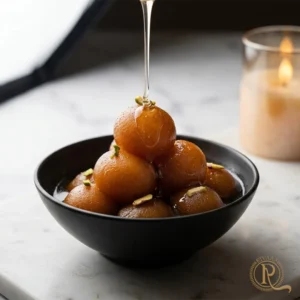
The Mughal Empire, which ruled the Indian subcontinent from 1526 to the mid-18th century, was one of the most culturally sophisticated in world history. The Mughal courts brought together Persian, Central Asian, and local Indian culinary traditions in a way that had never happened before, and the result was a cuisine of extraordinary depth and refinement.
The royal kitchen, known as the shahi matbakh, employed hundreds of khansamas, or court chefs, who were tasked not only with feeding the emperor but with creating dishes worthy of the imperial table. Sweets held a particularly important place in this culture. They were offered at celebrations, used as diplomatic gifts, and served at the close of royal banquets as a mark of generosity and abundance.
The Mughals did not invent sweetness. But they perfected it. They took the Persian tradition of cooking with rose water, saffron, and milk, combined it with the Indian abundance of sugar cane and dairy, and created a repertoire of confectionery that the world has never forgotten.
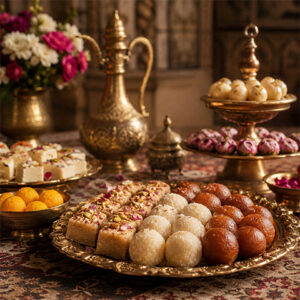
The name says everything. Gulab is the Persian word for rose, a reference to the rose water that perfumes the sugar syrup. Jamun refers to the Indian blackberry fruit, whose dark round shape the fried sweet resembles. The sweet itself is believed to have evolved from a Persian dessert called Luqmat al-Qadi, small fried dough balls soaked in honey, which traveled to the subcontinent through Mughal trade and cultural exchange.
In the royal kitchens, the recipe was refined: khoya replaced simple dough, giving the sweet its signature dense and milky interior, and the syrup was elevated with cardamom and kewra water alongside rose water. The result became one of the most beloved traditional Pakistani mithai in history.
A well-made Gulab Jamun should melt the moment it touches your tongue. That quality comes from the khoya, which must be freshly made and kneaded to exactly the right consistency before frying. At RIVAAJ, this is done by hand every morning.
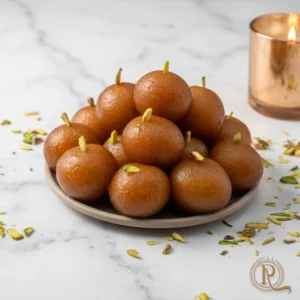
Barfi takes its name from the Persian word for snow, barf, a reference to the milk-white colour of the plain version. At its most essential, Barfi is khoya cooked with sugar until it firms into a sliceable block. But in the Mughal tradition, simplicity was always a starting point, never an endpoint.
The royal kitchens produced Barfi layered with saffron and rose water, studded with pistachios from Afghanistan and almonds from Persia, and sometimes wrapped in edible silver leaf, known as vark. Each addition was a signal of status and refinement. Today, Barfi remains one of the most versatile sweets in the traditional Pakistani mithai repertoire, ranging from the plain and humble to the elaborately gifted.
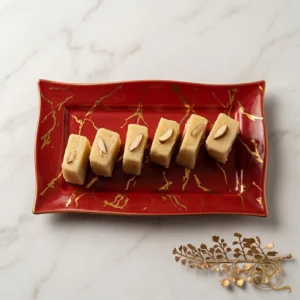
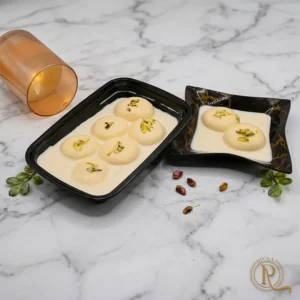
Ras Malai means juice of cream in Urdu, and few names in the entire world of traditional Pakistani mithai are more accurate. Soft discs of chenna, a fresh curd cheese made by curdling full-fat milk, are poached in a light sugar syrup until they become almost weightless, then submerged in a chilled saffron-tinted milk cream perfumed with cardamom and rose water.
The Mughal influence is unmistakable. Saffron imported from Kashmir and Persia, rose water as a defining aromatic, and the obsession with slow milk reduction that runs through the entire royal kitchen tradition all come together in Ras Malai. It required not just skill but time and restraint, and that is precisely what made it worthy of an imperial table. At RIVAAJ, it is served chilled because that is how the flavours open fully.
As the Mughal Empire declined and regional kingdoms rose across the subcontinent, the royal recipes traveled with the chefs who had mastered them. Many of the greatest halwai families of Lahore, Multan, and Delhi trace their craft directly to kitchens that once served emperors.
When Pakistan was established in 1947, these recipes became part of the national identity. The mithai shop was not just a business. It was a cultural institution, a place where families gathered before weddings, where children were taken after exam results, where neighbours arrived with trays to share good news.
For the Pakistani community in Riyadh, that connection does not disappear with distance. It becomes more important. Traditional Pakistani mithai is not just food. It is the taste of belonging, of home, of a culture that carries its history in every bite.
At RIVAAJ Sweets and Bakers, we make these sweets the way they were meant to be made: fresh, by hand, with pure desi ghee and authentic ingredients. The recipes are old. The commitment to them is absolute.
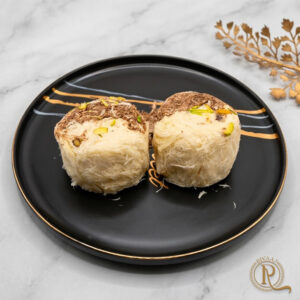
Every sweet we make at RIVAAJ carries this heritage. Gulab Jamun, Barfi, Ras Malai, Halwa, Kalakand, each one is a piece of a story that is over five hundred years old, prepared fresh every day in Riyadh for the community that never stopped loving them.
• Visit us: RBJA7981 Building 7981, Riyadh 12734
• Order on Keeta or HungerStation for same-day delivery across Riyadh
• Gift boxes and bulk orders: WhatsApp +966 54 777 7683
• Custom Eid, wedding, and corporate trays available with advance notice
Every bite carries tradition. Every box carries joy.
What is the origin of traditional Pakistani mithai?
Traditional Pakistani mithai has its roots in the Mughal Empire, which ruled the Indian subcontinent from the 16th to 18th centuries. Mughal court chefs, influenced by Persian and Central Asian culinary traditions, developed many of the milk-based and sugar-syrup sweets that are now staples of Pakistani cuisine, including Gulab Jamun, Barfi, Halwa, and Shahi Tukray.
Which Pakistani sweet has the oldest history?
Halwa is among the oldest sweets in Pakistani culinary history, tracing its origins to the Arabic word for sweet and arriving on the subcontinent through Persian influence even before the Mughal era. However, Ras Malai and Gulab Jamun were refined and popularised during the height of the Mughal Empire in the 16th and 17th centuries.
What does Gulab Jamun mean and where does it come from?
Gulab Jamun means rose berry in Persian and Urdu. Gulab means rose, referring to the rose water used in the sugar syrup, and Jamun refers to the Indian blackberry fruit whose size and dark colour the fried sweet resembles. It is believed to have been inspired by a Persian dish called Luqmat al-Qadi and developed in Mughal royal kitchens.
What makes traditional Pakistani mithai different from other sweets?
Traditional Pakistani mithai is defined by the use of khoya, pure desi ghee, and natural aromatics such as cardamom, rose water, kewra, and saffron. These ingredients give the sweets a depth of flavour and fragrance that cannot be replicated with shortcuts. The preparation methods, many of which require hours of slow cooking, are also central to what makes these sweets distinct.
Where can I find authentic traditional Pakistani mithai in Riyadh?
RIVAAJ Sweets and Bakers in Riyadh makes traditional Pakistani mithai fresh daily using authentic recipes and pure desi ghee. Visit at RBJA7981 Building 7981 Riyadh 12734, or order via Keeta and HungerStation. Custom gift boxes and bulk orders are available via WhatsApp at +966 54 777 7683.
Every bite carries tradition. Every box carries joy.